
They’re Not Failing. And Neither Are You.
On frustration, early responsibility, and raising children who get to grow up slower than we did
Also Featured on Substack & Medium
Feb 16, 2026
They’re Not Failing. And Neither Are You.
Today is Presidents Day, the last day of a four-day weekend.
The house feels slower. Backpacks aren’t lined up by the door yet. Snow boots are scattered but not urgently needed. There’s a softness in the air before alarms start ringing again tomorrow morning, and I’ve been thinking about a morning from last week.
The rush.
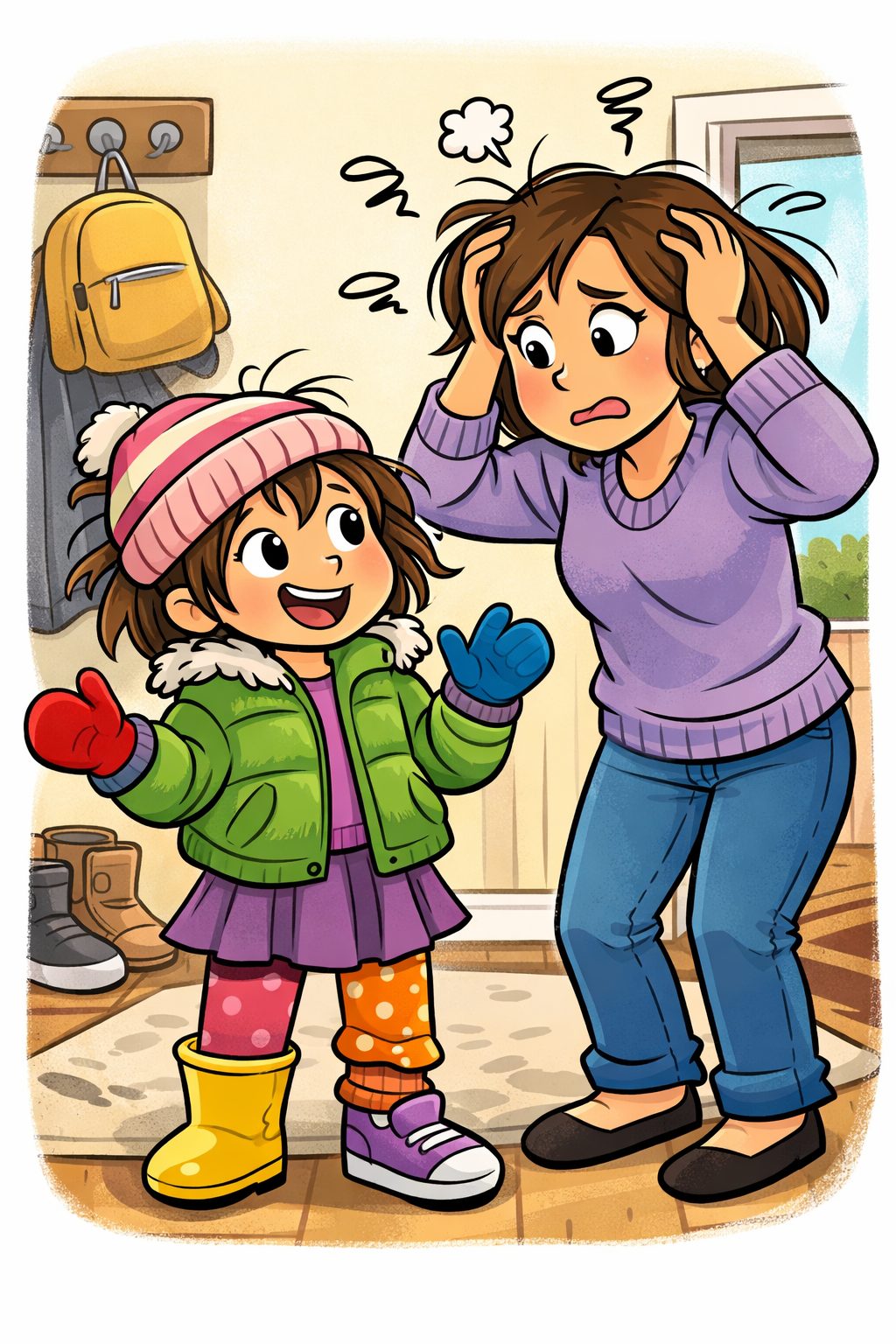
The missing gloves.
The backward pants, and forgotten garbage.
The panic rising in my chest over something that, in the grand scheme of life, really isn’t that big.
I’ve been reflecting on how quickly frustration can show up in parenting, especially in the small, repetitive moments. The boots. The hair brushing. The “Why can’t you just…?” thoughts that flash before we even realize they’re there.
But what if those moments aren’t really about our kids?
What if sometimes the intensity we feel has more to do with the pace we were forced to grow up at than the pace they’re growing at now?
This isn’t an article about being a perfect parent.
It’s about being an honest one.
It’s about recognizing that frustration doesn’t automatically mean failure, and that children who grow up slower than we did might not be behind at all. They might just be safe.
Before you keep reading, I want to invite you to gently ask yourself:
When my child frustrates me, what part of my own story might be getting touched?
Section One: The Morning It All Felt Too Loud
Last week, on an ordinary school morning, everything felt louder than it should have.
I have an 18-year-old and a 6-year-old still at home, and the contrast alone can be disorienting. One is technically an adult but still forgets things sometimes. The other is six, which means backward pants, missing gloves, and snow gear battles are part of the terrain.
I lay my youngest’s clothes out to help streamline the morning. She still sometimes puts her pants on backward. Hair brushing often turns into a small battle. Gloves disappear daily and then randomly reappear days later as if they’ve been on a journey of their own.
That morning, I had just been talking to ChatGPT about it, half joking, half genuinely seeking perspective. The advice was simple: let her do more for herself. Let her practice. Let her figure it out. Step back instead of micromanaging.
As I looked up from that conversation, she was standing in front of me with one boot on, trying to pull her snow pants over her jacket.
It was almost comical, like the universe decided to test my new parenting philosophy immediately. It was also very overstimulating, though.
Three weeks earlier, I had quit smoking weed, I’d been getting over being sick. I hadn’t fully realized how much it had been buffering my overstimulation. Without it, the mornings feel raw. The ticking clock feels louder. The pressure to get everyone out the door on time hits harder. I don’t even think I’m afraid of being late, I think I’m afraid of losing control of the flow.
I could feel the panic rise in my chest. I raised my voice, not cruelly, not explosively, but sharper than I wanted to. Urgency leaking out sideways, and almost immediately, guilt followed. The spiral: Did I just ruin their day? Am I becoming the kind of mom I don’t want to be?
What struck me later wasn’t that I had been frustrated.
It was that I wasn’t actually frustrated with them.
After they left, I was talking with my ex’s brother and his girlfriend. We were reflecting on how we were raised, how young we had to become responsible. How capable we were expected to be before we were ready. How there wasn’t space for forgetfulness or inefficiency. You just pulled it together, and I realized something uncomfortable:
When I watch my children struggle with small things, something in me gets confused. I look at them and think, How can this be so hard?
But that reaction isn’t really about their ability.
It’s about the fact that I didn’t get to struggle safely.
That I didn’t get to grow up slowly.
Suddenly, I realized the backward pants and missing gloves weren’t the issue at all. It was about me.
Section Two: What’s Actually Normal (And What We Forget)
It’s easy, in the middle of a rushed morning, to interpret forgetfulness as defiance, slowness as laziness, and disorganization as carelessness. When we’re stressed, our brains look for meaning quickly, and they don’t always choose the most generous explanation.
But developmentally, a six-year-old losing gloves, putting pants on backward, struggling with sequencing winter gear, resisting hair brushing, and needing repeated reminders is not a red flag. It’s normal.
Children develop executive functioning skills, planning, sequencing, organizing, time awareness, and impulse control gradually. The prefrontal cortex, which governs those skills, is one of the last areas of the brain to mature fully. At six, children are not meant to be efficient. They are meant to be learning, and learning often looks messy.
Executive functioning isn’t just about knowing what to do. It’s about holding multiple steps in mind at once, prioritizing them in the right order, inhibiting distractions, and tolerating minor discomfort along the way. That is a lot to ask of a young brain. Snow gear alone requires sequencing: boots, snow pants, coat, hat, and gloves. For an adult, that’s automatic. For a six-year-old, that’s five separate cognitive steps competing with sensory input, curiosity, and whatever imaginative storyline is playing in their head at the time.
Every child develops at their own pace. Some children appear naturally organized or unusually self-directed early on. Others need repetition, reminders, structure, and scaffolding for longer. Both can fall within a healthy developmental range. What often gets mislabeled as not pulling it together is simply a brain that is still wiring itself.
Children this age are also developing autonomy. When they resist hair brushing or insist on doing something their way, they are not necessarily opposing us; they are practicing independence. The developmental task of early childhood is learning, I can do this myself. That experimentation can look inefficient, stubborn, or frustrating, but it’s actually healthy. They aren’t trying to frustrate us; they’re learning how to be human.
Here’s the part we don’t talk about enough: sometimes the children who seem hyper-capable, hyper-organized, and unusually mature at young ages weren’t simply advanced. Sometimes they were adapting. There is a difference between developmental readiness and survival-based responsibility. One grows from safety. The other grows from necessity.
When a child learns early that mistakes lead to shame, punishment, or chaos, they may become unusually vigilant. They may double-check everything. They may anticipate needs before being asked. They may seem “so responsible for their age.” Responsibility is not inherently negative, but the source of it matters. Was it nurtured gently over time, or was it required for stability?
When we grew up needing to manage more than we should have, our brains were wired for competence quickly. We learned to anticipate, organize, remember, and handle things early, not necessarily because we were developmentally ready, but because the environment demanded it. So when we look at our children and see inefficiency, our nervous system doesn’t always interpret it through a developmental lens. It interprets it through contrast. And contrast can feel like chaos.
Slow can feel unsafe. Forgetful can feel irresponsible. Struggle can feel like something is going wrong. But in a secure environment, struggle is how the brain grows. In a safe home, mistakes are data, not danger. Sometimes the very behaviors that irritate us are evidence that our children are developing at a pace that is appropriate for their age, not accelerated by stress.
That realization can bring mixed feelings. Relief, because maybe nothing is wrong. Grief, because maybe what felt normal in our own childhood wasn’t actually age-appropriate. Awareness, because the contrast forces us to look at parts of our history we might not have examined closely. When we acknowledge what is developmentally normal for them, we often have to face what may not have been normal for us. And that can be uncomfortable.
This is not about shaming parents of the past, nor is it about blaming families who did what they had to do. Sometimes growing up fast isn’t a parenting failure; it’s a survival necessity. Economic hardship, instability, trauma, single parenthood, cultural expectations, many families operate in conditions where children step up early, not because someone wanted them to, but because the system demanded it. That is not always cruelty. Sometimes it is reality, and that reality is sad. But it is also true.
Parenting is hard. Living is hard. There are seasons in life where everyone is just doing their best to get through the day. Some children grow up quickly because their caregivers are overwhelmed. Some grow up quickly because resources are scarce. Some grow up quickly because there simply wasn’t another option. Acknowledging that does not erase the impact, and acknowledging the impact does not require us to villainize anyone.
What it does mean is that when we feel a spike of frustration watching our own children move slowly, forget things, struggle, or resist, that reaction may carry layers. It may carry memory. It may carry grief. It may carry pride in how capable we became and sorrow for why we had to become that way.
Two truths can exist at the same time: growing up fast can build strength, and it can cost something. Allowing our children to grow slower can feel beautiful, and it can stir up complicated emotions.
None of that makes you a bad parent.
It makes you human.
Section Three: The Mother I Wanted to Be
I have always wanted to be the mom who is sweet, caring, calm, cool, and collected. Long before I ever had children, I was trying to figure out how to be that kind of parent. I took child development and child psychology classes, every childhood-focused course I could fit into my schedule, because I wanted to understand what I hadn’t been taught. I watched shows like Family Matters, Full House, and others not just for entertainment, but as quiet research. I studied how parents handled conflict. How they apologized. How they stayed calm. I was trying to learn how to be better one day, for my future kids, but also for my siblings.
I imagined being the kind of mother whose voice never sharpens, who responds instead of reacts, who kneels down at eye level and handles every moment with measured patience and warmth. And while I don’t often explode outwardly with frustration or anger, there were years I was deeply ashamed of how I parented. I can say that now without collapsing under it because I can hold two truths at the same time: I have compassion for myself, and I have regret.
I was a young mom. I was working overnights. I was trying to untangle trauma while helping care for family, manage a relationship, and actively raising children. I was overextended emotionally, financially, and physically. There were seasons where survival took priority over softness, where safety had to come before calm, and sometimes when you only have different poisons to choose from, you pick the one that won’t kill you. That doesn’t mean it doesn’t cause damage.
After my divorce, when I moved into my new home, I remember a moment so clearly. My daughter was four. She was full of energy, wild, bright, loud in the way children are when they feel free. She would run through the house laughing, screaming, spinning in circles. And I remember feeling something in my brain that I can only describe as static. Too much input at once. My body would tense. My chest would tighten. I could feel anger rising, not because she was doing anything wrong, but because my nervous system felt overloaded.
One day, as she ran through the house laughing, and I felt myself about to raise my voice, something inside me interrupted the reaction. A quiet voice asked, “Are you really mad about this… or is this about you?” That question stopped me. Because I realized something uncomfortable. It wasn’t safe for me to be loud growing up. I had spent years trying to keep my siblings quiet, trying to anticipate moods, trying to make sure no one caught the heat of dysregulated adults. “Kids are meant to be seen, not heard” wasn’t just a phrase, it was a survival rule. Loudness meant risk. Joy that drew attention meant consequences. Chaos meant danger.
So when my daughter ran through the house laughing freely, my body didn’t register safety. It registered threat. Not because she was unsafe, but because I had been.
That realization reshaped more than just that moment. It reshaped the snow pants and the missing gloves too. Her inefficiency in the morning. Her backward pants. Her resistance to being rushed. Her loud joy in the living room. She is the way she is because we allowed her to be a child. She is full of life, laughter, and freedom to be herself because we created enough safety for that to exist. The very things that spike my nervous system are often evidence that she does not have to live in survival mode, and that is something I once prayed for.
So often, we take kids being kids and label it disrespect, laziness, defiance, or irresponsibility. But sometimes what’s actually happening is much quieter and much more internal. Our bodies are reacting to old memories. Our nervous systems are signaling past danger. We are subconsciously trying to protect our children from what once hurt us. But here is the hard truth: if we are not careful, we can become the threat we once feared. Not because we are cruel, or because we don’t love them, but because unhealed wounds project themselves forward.
When my daughter runs through the house screaming with laughter, she is not endangering anyone. But my body remembers when that kind of noise did. When my six-year-old struggles to get dressed efficiently, she is not failing, but my nervous system remembers when mistakes weren’t allowed. The work isn’t in eliminating frustration. The work is in recognizing that sometimes the danger our body is responding to is no longer present. It is memory. And when we pause long enough to separate the present from the past, something shifts. We stop parenting from projection. We start parenting from awareness. And awareness is where healing begin, not perfectly, not instantly, but intentionally.
Section Four: The Nervous System Doesn’t Know the Difference Between Then and Now
One of the hardest parts about this kind of growth is that understanding something intellectually does not immediately calm the body. You can know your child is safe. You can know they are developmentally normal. You can know they are not being disrespectful. And still feel your chest tighten. That’s because the nervous system does not operate on logic first. It operates on pattern recognition.
If your body learned early that loudness meant danger, it will react to loudness before your brain has time to evaluate context. If your body learned that mistakes led to shame or consequences, it will react to inefficiency as if something is wrong. If your body learned that chaos meant instability, it will respond to disorder with urgency. The nervous system does not carefully assess timelines, or pause to ask whether this is the present moment or an old one. It simply scans for familiar signals and activates protection.
That activation can feel like irritation and panic or overstimulation, like static in your head, or like your capacity shrinking in real time, and if you’ve relied on something to buffer that activation, like I did with weed, you may not fully realize how sensitive your system is until the buffer is gone. Three weeks after quitting, I started noticing how raw mornings felt. The ticking clock sounded louder. The noise felt sharper. The urgency rose faster. Nothing about my children had changed. My nervous system just didn’t have the same filter.
That realization was uncomfortable, but also clarifying. Because once I stopped labeling myself as impatient or failing, I could start labeling what was actually happening: activation. My body was trying to protect us from something that wasn’t happening anymore.
This is where reparenting begins.
Reparenting is not just about how we treat our children. It is about how we treat the younger parts of ourselves that learned to survive in environments that required vigilance. When I feel that surge of urgency, I can now ask: What does the younger version of me believe is happening right now? What did she have to manage? What was she protecting?
A part of growing up, truly growing up, is becoming responsible for how we choose to move forward. Not responsible for what happened to us. Not responsible for what we were handed, but responsible for what we do with it now.
We cannot change the environments that shaped us, but we can change how we interpret and respond to the present.
Activation is not destiny. Just because your nervous system learned to react quickly does not mean you are stuck reacting that way forever. Neuroplasticity, the brain’s ability to rewire itself, continues throughout our lives. Every time you pause before raising your voice, every time you repair after snapping, every time you ask, Is this about now or then? you are teaching your body a new pattern. You are showing that this moment is not the old moment. You are teaching it that loud laughter is not danger, that backward pants are not instability, and that struggle is not catastrophe.
The beautiful thing about being human is the ability to change, grow, and heal. Patterns passed down without conscious intention can be examined and reshaped. Generational survival strategies that no longer serve can be interrupted. A different response is always possible.
Repair matters more than perfection ever will. If you raise your voice and then circle back and say, I was overwhelmed. That wasn’t about you, you are modeling accountability and emotional maturity.
You are teaching your child something many of us were never taught: that mistakes can be acknowledged without shame, that emotions can be owned without collapse.
Healing does not mean you never react again. It just means the gap between reaction and awareness gets shorter. Projection becomes easier to see. Old patterns loosen their grip and new ones begin to take their place.
A history does not disqualify you from being a good parent. Survival responses that once kept you safe do not have to dictate how you show up today, and even if some echoes remain, you are not the same person you were five years ago.
The nervous system may not automatically know the difference between then and now, but you can teach it, and every time you choose awareness, every time you repair, every time you soften toward yourself instead of spiraling into shame, you are doing something profound.
You are not just parenting your child.
You are reparenting yourself, and that changes everything.
Section Five: The Beauty in It
There is something quietly beautiful about a child who forgets their gloves.
About backward pants and messy mornings and laughter that echoes too loudly through the house.
There is something sacred about a child who feels safe enough to be inefficient. Safe enough to experiment. Safe enough to move slowly. Safe enough to be loud.
Forgetfulness can be proof of support.
Wild laughter can be proof of freedom.
Inefficiency can be proof that survival is not their full-time job.
It doesn’t mean we’re perfect parents, or that we never get overwhelmed or raise our voices or wish mornings ran smoother. But it does mean something important: our children are not operating from fear.
And that matters.
Many of us grew up measuring the room before we entered it. Managing moods. Anticipating consequences. Pulling it together quickly because there wasn’t space not to.
Our children fumbling through snow gear or running through the house laughing isn’t disrespect.
It’s evidence that they don’t have to monitor the emotional temperature the way we did.
How beautiful is that, truly.
It’s also complicated, I get that. Because when we watch them grow up slower than we did, it can stir grief and frustration. It can remind us of what we didn’t have. It can surface parts of us that learned too early how to be small.
But if you step back for a moment and look honestly at the life you are creating, you might see something powerful.
Your child is free in ways you weren’t.
And you helped make that possible.
Maybe it wasn’t perfect. Maybe you had seasons where you were overwhelmed. Maybe you’re still learning how to respond instead of react. But if your child feels safe enough to forget things, to be loud, to be messy, to take their time growing up, that says something about you.
It says you are not the environment you survived.
It says you have already shifted something.
If you look back at the younger version of yourself, the one who had to grow up quickly, who had to manage more than she should have, I wonder what she would say if she saw the parent you are now.
I have a feeling she might wish she had someone like you in her corner.
You are not a bad parent for feeling frustrated.
You are a human parent raising a child who feels safe enough to be a child.
And that, even on the loud, messy, overstimulating mornings, is something worth honoring.
Thank you for reading and allowing me to share this reflection with you. If this resonated, I hope it offered not just understanding, but gentleness toward yourself.
Parenting is layered. Healing is layered. Being human is layered. And the fact that you are willing to reflect at all tells me you are doing deeper work than you probably give yourself credit for.
As we move into a new week, I’m wishing you slower mornings where you can find them, softer reactions when you need them, and the awareness to separate memory from moment when it matters most.
If something here resonated with you, you may also want to explore the Hellbloom Haven Trauma Portal, a free educational resource designed to help people better understand trauma, how it affects us, and tools that support healing and self-awareness.
Hellbloom Haven also offers:
• Come As You Are peer support sessions
• Elderly companion conversation sessions
• Intuitive readings and guidance
• Books, poetry, and creative healing tools
Whether you’re here simply to read or looking for deeper connection, I’m grateful you’re part of this space.
Wishing you a beautiful week ahead.
Discover more from Hellbloom Haven
Subscribe to get the latest posts sent to your email.

Leave a Reply