Comfort, Complicity, and the Cost of Looking Away
Why having privilege isn’t wrong, but ignoring it is.
Jan 26, 2026
Comfort, Complicity, and the Cost of Looking Away
What Privilege Really Means
Privilege (n.): a special right, advantage, or immunity granted or available only to a particular person or group.
It sounds like such a loaded word, doesn’t it?
For some people, it stirs defensiveness, and for others, it’s something they carry without fully recognizing it.
But at its core, privilege just means access to safety, to resources, to freedom from certain kinds of fear, or scrutiny.
This piece isn’t about blaming anyone for having privilege.
It’s about what we do with it, because privilege is neutral until we decide how we use it.
I want to be clear: I didn’t just wake up to injustice.
I grew up in Minnesota, surrounded by friends and loved ones who are Native American. I saw early on how differently they were treated, in schools, in stores, by law enforcement. I’ve never been blind to racism in my own family or outside of it, or the way Black and Brown communities are targeted, profiled, or punished for things others are excused for.
This isn’t new, but what is happening now in the United States and in Minnesota feels more blatant, less hidden behind polite language or excuses.
Lately, I’ve noticed something heartbreaking:
Even people I care about deeply, people who have experienced real pain, trauma, and hardship in their own lives, still find ways to justify what’s happening right now in our country.
They say things like:
“Well, if they didn’t break the law…”
“That’s not really happening.”
“It’s not as bad as people say.”
I get it. These aren’t cruel people.
Many of them have been hurt, silenced, betrayed, and let down by systems themselves.
But here’s what I’ve come to understand:
It’s possible to have suffered deeply and still not understand the fear of being targeted not for what you’ve done, but for who you are.
It’s possible to have trauma and still have privilege in ways you don’t realize.
The ability to look away, to not have to know, to be able to choose not to engage, that’s privilege.
The fear that families in immigrant and Indigenous communities are living with right now isn’t vague. It isn’t theoretical. It’s not even based on what might happen, it’s based on what already is. Their fears are very real and rational.
Lately We’ve seen, not just this week, but over and over again, that fear isn’t limited to just people without documentation.
In Minnesota, we lost Rene Good, a Native woman, a mother, taken too soon in a system that didn’t see her as worth protecting.
We lost Alex Pretti, a white man, a legal gun owner, a veteran and ICU nurse, gunned down in public.
And just like that, the narrative falls apart.
ICE, law enforcement, and the larger systems of power in this country have shown their hand. This is no longer about paperwork. It’s not about “illegality.”
It’s about control, it’s about dominance, and about who is seen as deserving of safety, and who is seen as expendable.
If we don’t start naming that, and owning where our privilege gives us the choice to ignore it, then we’re not just silent, we’re also complicit.
Section 1: What Privilege Really Means, and Why It Matters Right Now
“Privilege” is a word that makes a lot of people uncomfortable. For some, it feels like an accusation. For others, it feels like something abstract, a concept that lives in academic discussions or online debates.
But here’s what it really means:
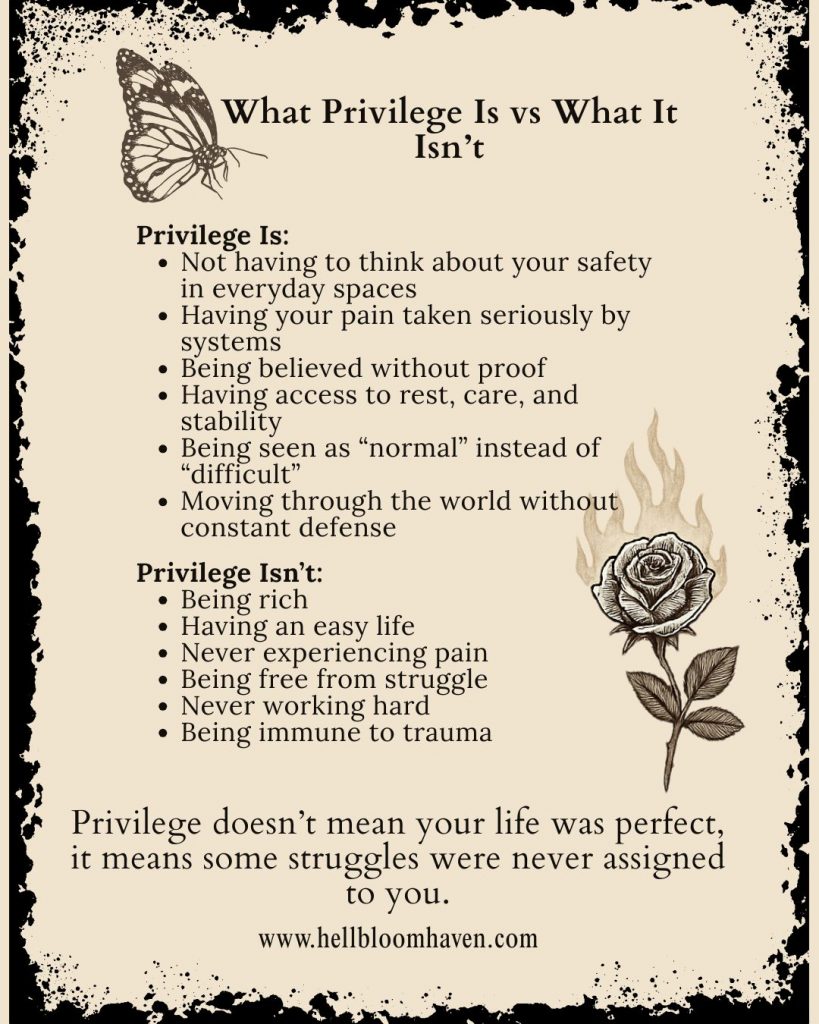
Privilege is not about what you’ve been through. It’s about what you’ve been spared.
It doesn’t mean you haven’t struggled. It doesn’t mean you haven’t suffered. It doesn’t mean life has been easy.
It means that whatever pain you’ve known, it wasn’t made worse by the color of your skin. Or the language you speak. Or your immigration status. Or your zip code. Or whether your last name sounded American enough to pass through a checkpoint without being questioned.
Privilege means your humanity is assumed, not interrogated.
And lately, I’ve been watching this show up in conversations with people I love. People who’ve lived through real trauma. People who’ve known injustice in other forms, abuse, violence, betrayal. People who have every reason to know what it feels like to be powerless.
But instead of extending that understanding to others, some are using their pain as a reason to justify someone else’s. As if harm becomes acceptable when it’s happening to “someone else.” As if surviving something gives us permission to stop caring about what others are going through.
And that’s the part I can’t wrap my head around.
To me, the whole point of surviving is to never wish the same thing on anyone else, to never stand by and let it happen again. Especially when you know what it feels like.
When we carry privilege, even if it’s in one area of life and not another, it’s not something to feel guilty about. But it is something to take responsibility for.
That means asking:
- Am I listening?
- Am I learning?
- Am I using my voice?
- Am I speaking up when silence feels more comfortable?
Privilege shows up in different ways, race, language, citizenship, money, appearance, ability. I’m a white woman. I have ADHD. I’ve struggled in ways most people will never see, and I’ve also passed through spaces that others never could, just because of how I look, how well I can “mask,” or how my name sounds on paper.
That doesn’t make me bad.
It makes me responsible.
When systems are targeting marginalized communities, Indigenous, Black, Brown, undocumented, disabled, poor, and people like me still get the benefit of the doubt, we don’t get to look away.
There have been moments lately that make it impossible to ignore what this has become.
Not just immigration enforcement, but fear-based control.
Five-year-old’s and disabled teens, taken from their homes and locked in detention centers where not even their most basic needs are being properly met.
Families are being separated without warning or process.
Children transported hundreds of miles away to unfamiliar facilities, often without the presence of a parent or even a clear plan for reunification.
These aren’t isolated incidents. They’re the pattern.
And the longer we try to justify them as exceptions, the longer we allow them to continue.
If every Jew, Roma, disabled person, and other targeted group had waited until the Holocaust directly affected them, it would have been too late.
By the time it’s at your door, the machine is already running.
The time to act is always when you still have the power to stop it.
I’m not writing this because I think I’m better than anyone. I’m writing this because silence has a cost, and I’m not willing to pay it anymore.
Section 2: When Power Protects the Privileged, and Turns Against Everyone Else
Privilege on its own isn’t the enemy.
But when power and privilege are concentrated in the hands of people who refuse to listen,
who refuse to understand, or even care, that’s when privilege becomes dangerous.
We live in a country where the people writing and enforcing the laws often live lives completely detached from the reality they legislate.
We have a president who has never once had to walk through this world as anything but powerful, who believes himself above the law, who will never know what it’s like to be a woman, an immigrant, a single parent, or someone surviving paycheck to paycheck.
We have senators and lawmakers who decide wages for the working class while living on salaries most Americans will never see in their lifetimes.
They debate food stamps and healthcare access from behind private gates and catered luncheons.
They make laws about public housing while owning multiple homes.
They cut education budgets while sending their own children to elite schools.
They write policy on poverty while profiting from the very systems that cause it.
These people have never stood in line at a food bank.
They’ve never wondered if they can afford both rent and insulin.
They’ve never buried their identity just to stay safe.
They’ve never lived on a reservation or navigated daily racism.
And yet they decide the fate of those who do.
And let’s talk about immigrants, the ones so many Americans have been taught to fear or blame.
This land was stolen from Indigenous peoples.
It was built on the backs of enslaved Black people.
It was shaped and sustained by generations of immigrants, many of whom were also fleeing war, hunger, and persecution.
And still, today, immigrants are scapegoated and criminalized.
Many of them have escaped things we cannot imagine.
They have lived through the collapse of governments.
They’ve seen firsthand what it looks like when fascism and authoritarianism rise, and how quickly a country can change.
So when they speak, when they warn, when they plead for dignity,
we should be listening.
Instead, they are hunted, caged, silenced, and dehumanized.
And while this happens, people in power use privilege, our privilege, against us.
They weaponize fear.
They keep us fighting each other so we don’t look up and ask who’s really benefitting.
They say “it’s about safety,”
but they ignore mass shootings.
They say “it’s about legality,”
but they break their own laws with impunity.
They say “it’s about jobs,”
but they outsource labor and exploit workers at every turn.
They pretend to protect us,
but they are only protecting themselves.
Privilege, in their hands, is not a gift. It’s a weapon.
And it’s being used to divide us, to distract us, to drain us.
Now here’s where I want to be clear:
I understand that people are complex.
Life is hard.
We are all carrying things: trauma, fear, generational wounds, misinformation, and exhaustion.
We all have a host of reasons for why we do what we do.
Why we stay silent, why we look away, why we vote a certain way, or
why we shut down.
But even with all that truth:
Actions have consequences and so does inaction and so does silence.
Being tired doesn’t erase harm.
Being scared doesn’t erase responsibility.
Being “a good person” doesn’t mean you are free from accountability.
Because harm doesn’t need to be intentional to be real.
Section 3: The Privilege of Never Having to Know
Privilege isn’t always about wealth, status, or material things.
Sometimes it’s about what you’ve never had to fear.
What you’ve never had to survive.
What you’ve never had to even imagine.
And that’s what this section is about: perspective.
Too often, people in the United States treat immigration like it’s a convenience.
People act like other people are just flooding across borders for fun or to steal from the government and people, like they are coming here to feed off of systems that barely work for most Americans and are already flawed.
Like it’s a line-jumping free-for-all, as if the journey here is easy, or safe, or even wanted.
But ask yourself:
Imagine for a Moment…
What would you do to protect your children?
What lengths would you go to, what discomfort would you endure, to give your loved ones a life safer, freer, and fuller than the one they were born into?
Would you risk everything, leave your home, your language, your family, your memories, to save them?
Because that’s what many people are doing.
No one willingly walks away from everything they’ve ever known just to struggle in a foreign land, unless staying is more dangerous than leaving. Unless there is no choice.
This is the privilege we so often don’t recognize:
To be born in a country where, for all its flaws, there are systems of support.
To know that if you lose your job, there are programs and safety nets to help you survive.
To be able to call 911 and expect help to come.
To have the right to speak up, the right to be seen, the right to ask questions without fear.
That doesn’t mean America is perfect.
People fall through the cracks here, too.
But in many other places, there aren’t even cracks, because there’s no floor at all.
No welfare.
No disability support.
No food stamps.
No shelters.
No legal aid.
No protection from violence.
No safe place to go when the world turns against you.
If you get hurt, you’re on your own.
If your child is sick and you can’t afford help, they die.
If you speak up, you’re imprisoned, or worse.
If your town is overtaken by war or gangs or corrupt regimes, there is no one coming.
And so people flee.
Not for luxury.
Not to “cut in line.”
But for survival.
They come here, hoping for safety, and are met with suspicion.
They’re called “illegals.”
They’re told to “go back.”
They’re locked in cages, denied medical care, stripped of dignity, and criminalized for existing.
They are punished for having the audacity to try to survive and live.
This is the privilege I’m talking about.
The privilege of never having to know what it’s like to run.
The privilege of assuming that if someone is being detained, it must be because they “did something wrong.”
The privilege of feeling shocked by stories of abuse because we’ve never had to live them.
The privilege of looking away because it isn’t happening to us, yet.
We don’t have to feel guilty for the privileges we have.
But we do need to be aware of them.
Because awareness leads to accountability.
And accountability can lead to change.
If you’ve never had to wonder whether your child will eat…
If you’ve never had to weigh staying in a violent country vs. crossing a border…
If you’ve never had to beg to be seen as fully human…
Then yes, you are privileged.
And recognizing that doesn’t make you a bad person.
It makes you someone who can choose to help.
Section 4: The Oldest Playbook, Divide, Distract, Control
History doesn’t repeat itself exactly, but it rhymes.
And if you’ve been paying attention, what’s happening now in the United States should feel eerily familiar.
We’ve seen these tactics before:
✅ Create fear
✅ Paint a group as dangerous
✅ Justify harsher laws
✅ Use violence to “restore order”
✅ Silence anyone who speaks out
It’s the oldest playbook, and it works.
Not because people are evil, but because people are scared and already struggling to stay afloat.
Because in abusive and oppressive systems, whether in homes or governments, people are trained not to question the one with power.
It feels too risky.
So they turn that fear sideways, onto the people who are less protected, more vulnerable, or easier to scapegoat.
This is what abuse does:
It convinces those who are suffering that someone else is the problem.
That if you punish the weaker one, you’ll be safe.
That if you stay close to power, it won’t turn on you.
But that’s the lie.
And here’s the heartbreaking truth:
Often the people being targeted aren’t even weaker, they’re just already under attack, already hurting, already marginalized.
They’re often survivors themselves.
They’re just less protected.
That’s what makes them easier to sacrifice.
This is how injustice survives, not just through the actions of the powerful, but through the silence of the rest of us.
It doesn’t need everyone’s cruelty, just enough people’s discomfort, denial, or distance.
So when the government tells us immigrants are the threat, or poor people are draining the system, or protesters are dangerous,
That’s not new.
That’s a tactic.
They’re pointing fingers at the vulnerable, so we stop pointing fingers at them. (AHEM EPSTEIN FILES?)
Section 4: When History Repeats, and Blame Becomes the Official Narrative
They say hindsight is 20/20.
But what good is looking back if we refuse to learn from it?
We’ve seen these tactics before, throughout history, governments and powerful institutions have responded to harm not by acknowledging responsibility, but by shifting the blame onto the people who were hurt, the people who were caught in the middle, or the people who were simply present.
Right now, we’re watching that pattern play out again.
Blaming the Jackson Family
A Minneapolis family, Shawn and Destiny Jackson, were driving home from their child’s basketball game when an enforcement operation escalated nearby and a flash-bang device was deployed under their SUV. Smoke and gas filled the vehicle, and the couple’s 6‑month‑old baby stopped breathing and required CPR. Their other children were hospitalized. This wasn’t a protest; they were just trying to get home.
Instead of expressing concern, the Department of Homeland Security (DHS) initially posted on social media blaming the family, suggesting they had “brought their children to a violent riot” and “endangered” them. The post was later deleted, but the sentiment revealed how quickly the narrative turned on the victims rather than the agency whose crowd control measures endangered them.
Officials defended the deployment as “reasonable crowd control,” even while the family maintained they were not participating in the protest and were simply trying to leave the area.
Renee Good’s Killing and the Official Spin
On January 7, 2026, 37‑year‑old Renée Nicole Good, a U.S. citizen in Minneapolis, was shot and killed by an ICE agent during an enforcement action. The Minnesota Medical Examiner later ruled her death a homicide.
Federal officials framed the encounter by alleging Good was a threat. That narrative was quickly echoed in conservative media, even as video and community accounts raised serious questions about the justification. Local leaders and human rights advocates have denounced the shooting and pushed back against the government narrative, arguing that residents had legitimate reason to be afraid of federal agents operating in their neighborhoods.
Alex Pretti: A Nurse Killed, Then Blamed
Just weeks later, on January 24, 2026, 37‑year‑old Minneapolis resident Alex Jeffrey Pretti, an ICU nurse and U.S. citizen with no violent record, was killed during a federal immigration enforcement operation. Authorities claimed he approached agents while armed and resisted, a narrative quickly circulated by the Department of Homeland Security.
But multiple verified videos and eyewitness accounts contradict that official version. In footage and testimony, Pretti is seen holding a phone, not a weapon, and appears to be assisting a woman who had just been pushed by agents when he was pepper‑sprayed, tackled, and shot at close range.
His family has publicly rejected the federal account as “sickening lies,” emphasizing his compassionate life as a nurse and caregiver, and urging the public to “please get the truth out.”
The Pattern Is the Point
This is the same system that tells us:
“Comply and you won’t get hurt.”
“If you’d just listen and follow orders…”
“Stay calm, and everything will be fine.”
But that rhetoric often falls apart on contact with reality. In practice it becomes:
- Justify force by claiming threat.
- Defend violence by blaming the victim.
- Shift focus from accountability to narrative control.
In every one of these cases, the Jackson family, Renée Good, Alex Pretti, the initial official responses were to paint the harmed party as the problem, rather than to acknowledge the harm or missteps in enforcement. And that’s not unique to this moment, it’s a well‑worn technique used by institutions when accountability is inconvenient.
History Knows This Story Too Well
Throughout history, people have been manipulated into believing narratives that protect the powerful at the expense of the vulnerable:
- People blame the oppressed for their own oppression.
- People rationalize brutality against some because it’s easier than confronting a system that harms everyone.
- People silence themselves, thinking that staying neutral means they’re safe, until the harm reaches their own doorstep.
This isn’t just a rhetorical tactic.
It’s a strategy of control.
If we are willing to repeat the same responses, to accept official narratives without scrutiny, to cast blame on victims, or to let silence stand as consent, then we are welcoming a future where accountability is optional and power is left unchecked.
None of these people, the Jacksons, Renée Good, Alex Pretti, were undocumented.
None of them were criminals.
They were citizens, parents, and caregivers.
They were people just living their lives.
And yet still, they were hurt. Still, they were blamed.
Still, their pain was denied or ignored.
This is what happens when privilege blinds us.
It allows people to believe the stories of the powerful, even when they contradict the truth.
It lets us pretend that suffering only comes for those who “deserve” it.
But no one deserves this.
If it can happen to them, it can happen to any of us.
We are only ever as safe as our most vulnerable, and if we turn away now, we won’t see what’s coming next.
Section 5: Privilege Is a Mirror, What We Choose to See, and What We Choose to Do
I’ve heard the testimonies, I’ve seen the videos, and I’ve sat with the stories.
I don’t just take what I see at face value; I look for both sides. I fact-check. I pay attention.
What I’ve come to realize is this:
These aren’t isolated incidents; they aren’t just rumors. These are lived realities.
Not all of them happened in front of cameras, and not all of them will ever be acknowledged by headlines.
But they are still true. Still happening. Still damaging.
I know there are countless others affected, far beyond the names and faces I’ve mentioned here. I know the people I’ve written about in this piece, many of them aren’t even the main targets of these systems.
That’s what makes this even more chilling.
To every one of you:
I see you. I believe you. I care about you.
You’re not invisible, even if they try to make you feel that way.
You’re not alone, even if the system wants you to believe you are.
This particular story is personal because it’s happening in my state.
But it could be anywhere. It is happening everywhere.
And that’s what privilege does, it blinds us to the scope.
It tells us we only need to care when the pain is close.
When it’s our neighborhood. Our family. Our friend.
When, in reality, the line between “them” and “us” has always been a lie.
We don’t have to live the same stories to be responsible to each other.
And we don’t have to experience the same pain to know when something is wrong.
Privilege isn’t inherently bad, most of us have some form of it.
Whether it’s the ability to blend in, access resources, speak without an accent, or walk through the world without fear of being profiled.
It becomes dangerous when it turns into detachment.
When we start believing our safety is deserved, and theirs is not.
When we start thinking our silence protects us.
That it keeps us clean.
That staying neutral makes us good.
It doesn’t.
Because eventually, the walls don’t stop with the people outside of them.
Eventually, the system we let grow in the dark turns around.
And when it does, the people we ignored won’t be a “them” anymore.
They’ll be us.
And by then, it may be too late.
Thank You for Reading
If you made it this far — thank you.
Thank you for sitting with something heavy.
Thank you for being willing to think, feel, and reflect.
This wasn’t easy to write, and maybe it wasn’t easy to read either.
That’s exactly why I had to share it, though, because silence only helps the systems that harm, and compassion only works when it’s practiced, not just posted.
If this moved something in you, or even just made you pause, I’m grateful.
At Hellbloom Haven, I offer:
- Peer support
- Energy healing and mapping
- Intuitive services and spiritual readings
- Poetry, tees, digital downloads, and more
Everything I do is rooted in the belief that healing is not just personal, it’s collective.
And if you want to keep reading, I also write regularly over on Substack and Medium, it’s free to subscribe or explore more reflections there.
We may not be able to fix everything, but we can choose not to look away.
We can choose to stay human, even in systems that try to make us forget what that means.
With care,
Wendi Kehn
Discover more from Hellbloom Haven
Subscribe to get the latest posts sent to your email.